Skip to content

For schools

A therapist in your school, and a practice behind them.

We place experienced, registered therapists in London’s independent schools, and carry the clinical governance, supervision and administration that sit behind good counselling. Each partnership is shaped around how your school already looks after its pupils.

At a glance

Schools
Independent prep and senior schools in London, from Reception to the sixth form
We offer
Counselling for pupils, wellbeing groups, support for staff and parents, and a free teachers’ shelf
Funding
By the school, by parents, or a mixture of the two
Safeguarding
Reporting to your DSL, in line with KCSIE 2026

What we offer

Four kinds of support, used alone or together

Counselling for pupils

  • Weekly, in school
  • 30 to 50 minutes
  • Led by the child

Weekly one-to-one sessions during the school day, in a private room the school sets aside for the work.

Sessions last 30 to 50 minutes, depending on age. The work is led by the child and paced with care: early sessions are about feeling safe and settled, and no one is pressed to talk before they are ready.

  • Written parental consent before counselling begins, for pupils under 16
  • Children told, in words that suit their age, what stays private and when we would need to pass something on
  • Close liaison with your DSL, within clear boundaries of confidentiality
  • Termly reviews with the school, and planned endings when a pupil moves on

Wellbeing groups

  • Groups of six
  • Year 5 to the sixth form
  • Timed to your calendar

Small groups of six, run in school for a whole year group.

Our 11+ wellbeing groups can help Year 5 and Year 6 pupils with the stress and anxiety of the assessment year. Children learn what stress and worry do in the mind and body (psychoeducation), practise ways to steady themselves, and find they are not alone in it. We shape groups for older pupils in the same way, around the pressures of their year: the move to senior school, the GCSE years and the sixth form. The groups are therapeutically informed, though they are not therapy and never turn into tutoring.

  • Groups a few times across the school year, or more regularly, timed to your calendar and shaped with your pastoral team for each year group
  • Support that reaches children who are not yet on anyone’s list
  • Optional workshops for parents

More about 11+ groups

Support for staff

  • Reflective consultation
  • Clinical supervision
  • Cover during absence

The adults who hold a school’s pastoral work need somewhere to think too.

We offer reflective case consultation for DSLs, heads of year and pastoral leads; drop-in time for staff worried about a pupil; independent clinical supervision for a counsellor you employ; and cover when your counsellor is on leave or between appointments.

  • Consultation that is collaborative and practical, never evaluative
  • Supervision outside line management, as the BACP and NCPS frameworks expect
  • Cover that holds existing work carefully and hands it back cleanly
  • Liaison with senior leaders and the SENCO on themes across the school

Support for parents

  • Parent consultations
  • Evenings and briefings
  • The teachers’ shelf, free

Parent consultations within the school context give parents a confidential place to think about what they are seeing at home, and how home and school can pull in the same direction.

We also lead parent evenings and briefings for staff, arranged term by term at a day rate.

Your pastoral team can also use The Parent Book, our library for parents, free of charge. Staff read the library in full and send a parent the chapter that fits the moment; the parent reads that chapter in full, free, with nothing to sign up to. There is nothing to procure and no licence to sign. More about the teachers’ shelf.

Free for your staff

The teachers’ shelf, from The Parent Book

When a parent stops a teacher at pick-up, the conversation often needs something careful to follow it. The teachers’ shelf gives your staff the whole of The Parent Book, our therapist-written library for parents. They send a parent the chapter that fits the moment, and the parent reads it in full, with nothing to sign up to.

  • Free for every member of staff with a school email address
  • No licence, no fee, and nothing for the bursar to sign
  • Parents who want the whole library can subscribe, and subscriptions help keep the shelf free
  • Every chapter closes with signposting to NHS, charity and professional support
  • Nothing in the library replaces your school’s own procedures
  • Supervision for your staff, if you want it, is arranged with the school and invoiced separately

Open the teachers’ shelf

Staff sign in with their school email address at theparentbook.com/staff. There is nothing to install.

What your staff can do on the shelf, in two minutes. Captions are available.Watch with audio description
The film in words

On screen: The navy cloth cover of The Parent Book, with its gold mark.

Parents bring their worries to school.

On screen: The cover lifts, and three cards are laid on the paper, each a subject from the library with its drawing: School stress, a stack of exercise books; Separation and divorce, two small houses; Screen time, a phone.

A stomach ache every Sunday night. A separation at home. A teenager on his phone until two.

On screen: The cards are taken away, and the teachers’ shelf is laid in their place, headed For school staff, Free to use.

You want to help, and you want to get it right. And the bell goes in five minutes.

On screen: Free to use is underlined in gold, then the shelf’s first words: Everything on this shelf is written or chosen by therapists, for parents.

The teachers’ shelf, from The Parent Book, is free for school staff. Everything on it is written or chosen by qualified therapists, for parents.

On screen: Won’t go to school is typed into the search, under the question What is the family facing? As it is typed, the common concerns fold away. The results come up under the box, 146 things across 12 kinds, and first among them the pack, School stress: what helps, beside its drawing.

Type what the parent told you, the way you’d say it.

On screen: The pack is lifted from the results with its buttons, Send, Preview and Add to a set, and its line is underlined: what to do first, what helps, what to try, and who else can help with school stress. A guide a parent can print or keep.

Start with the pack: what to do first, what helps, and who else can help.

On screen: Send is pressed, and the box for sending it opens. The teacher leaves the parent’s first name blank, since it is optional, and types a line of her own: Good to talk this morning. I thought this might help. Beside it, What the parent sees shows the same line at the top of the page, letter by letter. Under her line, the shelf asks her to write nothing about the child.

Press Send, and add a line from you, if you’d like. You’ll see exactly how it will read.

On screen: Copy the link is pressed, and reads Copied. Beside it are Email it and Copy a message.

Then copy the link, or a message that’s ready to go, into whatever you use to write to parents.

On screen: The page the parent opens, as her phone shows it: Passed on by a member of staff at your school, with the teacher’s line beneath it, then Written by the therapists at Kensington Square Therapy. Free to read in full, with nothing to sign up to.

The page she opens says it came from her child’s school. And it’s free for her to read in full, with nothing to sign up to.

On screen: The page turns to its night colours, and moves down to What to do first.

She can read it tonight, when the house is quiet, and come back to it whenever she needs.

On screen: Its first step is underlined: Take the physical symptoms seriously. The Sunday stomach ache is real.

And you didn’t have to write the advice yourself, or wonder whether it was right.

On screen: Back on the shelf, every subject is opened, in its groups, and then the age is set to Secondary. Then Worth having ready, this half-term’s three, chosen by the therapists who write the library: Transitions, Friendships and Anxiety, each with its drawing.

When you’ve got longer, browse every subject, by age. Or take what our therapists would have ready this half-term, and put it in the newsletter.

On screen: At the top of the shelf, Ask a therapist is pressed, and the shelf goes to When a page is not enough, three ways to ask the therapists at Kensington Square Therapy: Ask for a page; Talk it through with a therapist, a call by telephone or video; and Supervision for you or your team, arranged with your school, and invoiced to the school. A therapist replies within two working days.

And when a page isn’t enough, ask us. For a page the shelf doesn’t have yet. For a call, to think something through. Or for supervision, for you or your team, arranged with your school. A therapist replies within two working days.

On screen: Talk it through with a therapist is opened. Under its form is the note that it is not for an emergency and not a safeguarding referral, and these words in it are underlined: follow your school’s safeguarding procedures and speak to your designated safeguarding lead today. The note ends with a link, If someone is in danger now. The form is closed again.

None of this replaces your school’s safeguarding procedures. It sits alongside them.

On screen: Pass it on: Anyone else here can use this too. Under Tell a colleague, its first line is underlined: The shelf is free for every member of staff with a school email address. Then Copy a note for a colleague is pressed. Beside it is the half-term note.

The shelf is free for every member of staff with a school email address. So find one thing that helps. Send it to a parent. And tell a colleague, here or at another school.

On screen: The navy cover returns, and gold is laid into its mark: The Parent Book. The teachers’ shelf, free for school staff, at theparentbook.com/staff.

Funding

Two ways to fund it, both in use today

We run each model with different schools, and can advise on what suits your size, culture and pastoral structure. A mixture of the two is also possible. Fees are discussed in the first conversation.

Funded by the school

The school commissions the work

The school engages KST by the hour, or for a half or full day in school, and receives a single invoice each term. This suits schools that want counselling open to every pupil, and whole-cohort work such as 11+ groups.

  • Hourly, half-day or full-day arrangements
  • One invoice to the school each term
  • KST still holds clinical records and manages consent
Funded by parents

Parents fund their child’s sessions

Parents contract with KST and pay for their child’s sessions directly, usually by Direct Debit. The school carries no cost and no billing; its part is the referral and a room. It can sit alongside an existing counsellor, adding capacity rather than replacing anything.

  • No cost or administration for the school
  • KST manages consent, invoicing and payment with families
  • Works alongside the provision you already have

How it works

From a first conversation to the first session

There is no template. We shape the service around your school, and keep the paperwork on our side of the line. We are bringing referrals, consent and session days into the KST Portal from November 2026.

  1. One

    A first conversation

    We talk about your school’s pastoral context, what is already in place and what you are looking for. There is no obligation.

  2. Two

    Shaping the service

    We agree what we will provide, on which days, and how it will be funded. We then set up your school’s space in the KST Portal, with one named contact, and your DSL as well if you would like.

  3. Three

    A written agreement

    We provide an agreement covering safeguarding, data protection, personnel and confidentiality. We send it through the portal, where it can be read and accepted, or on paper if you prefer.

  4. Four

    Referral, in the portal

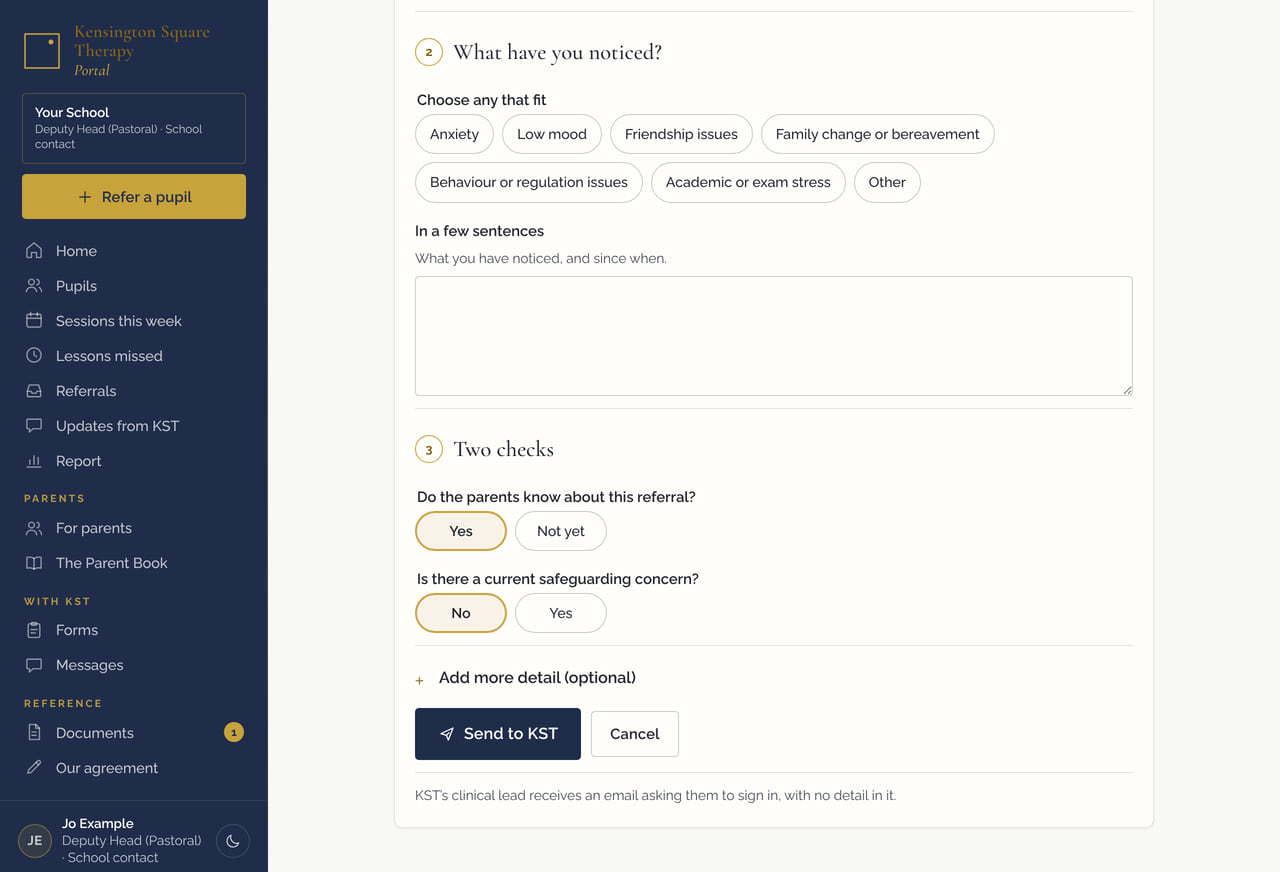
    Your school’s contact refers a pupil in about a minute. The form asks whether the parents know, and whether there is a current safeguarding concern; if there is, it asks your school to speak to its DSL first, and the referral can be sent once the DSL knows. A referral can come before consent: we get in touch with the family once they know, and counselling never begins without consent.

  5. Five

    Consent

    For pupils under 16, a parent gives written consent before any counselling begins. Your school can send the consent form through the portal, or we send it.

  6. Six

    Sessions and review

    Sessions are booked around the timetable, and your school’s contact can see the days, attendance and the lessons missed across a term. Termly reviews keep the school informed at the right level as the partnership grows.

Who gives consent

For children under 16, a parent with parental responsibility gives written consent before counselling begins. Young people of 16 and 17 can consent for themselves, and their capacity to do so is considered in line with professional guidance. Where parents pay for the counselling, we ask for their agreement as well.

The referral form: what has been noticed, then two checks, whether the parents know and whether there is a current safeguarding concern, and a Send to KST button. A note beneath says the email to KST’s clinical lead has no detail in it.
Step Four in the KST Portal: the second half of the referral form, as your school’s contact sees it on a computer. A worry about a child’s safety goes to your school’s DSL, not through the portal. Every record shown is made up.

The KST Portal

One private place for the work, for your school and for parents

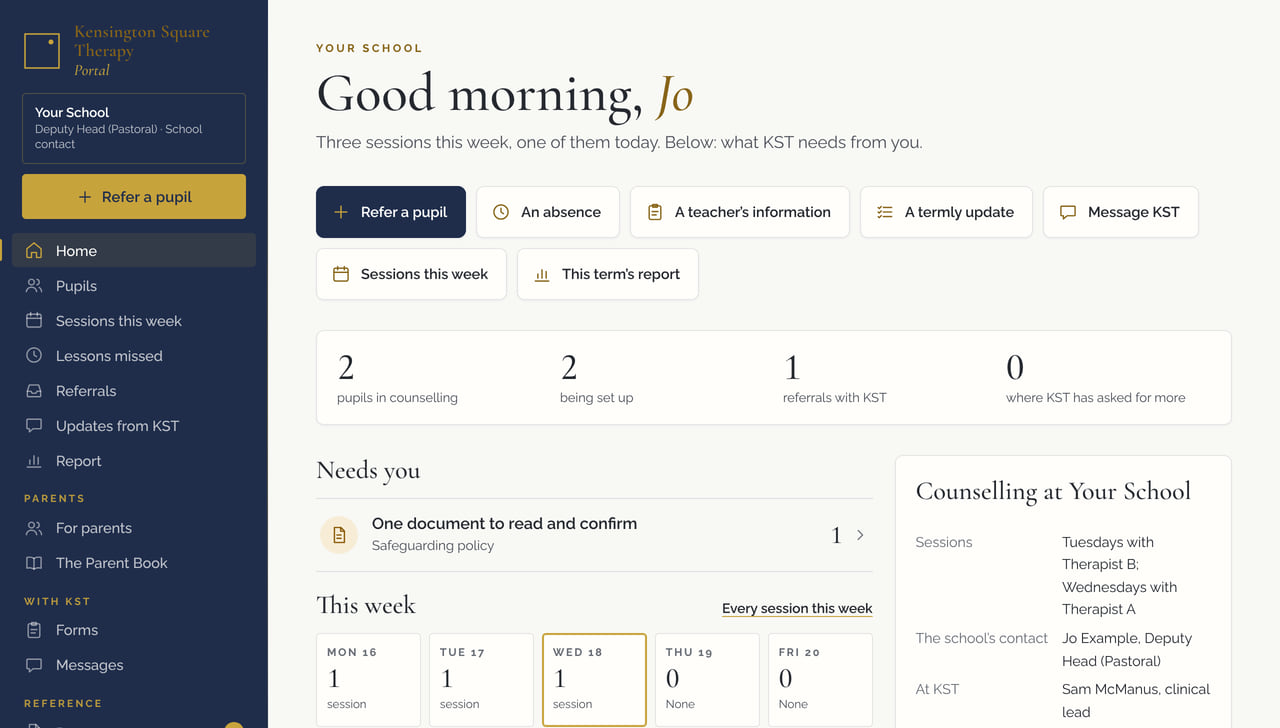
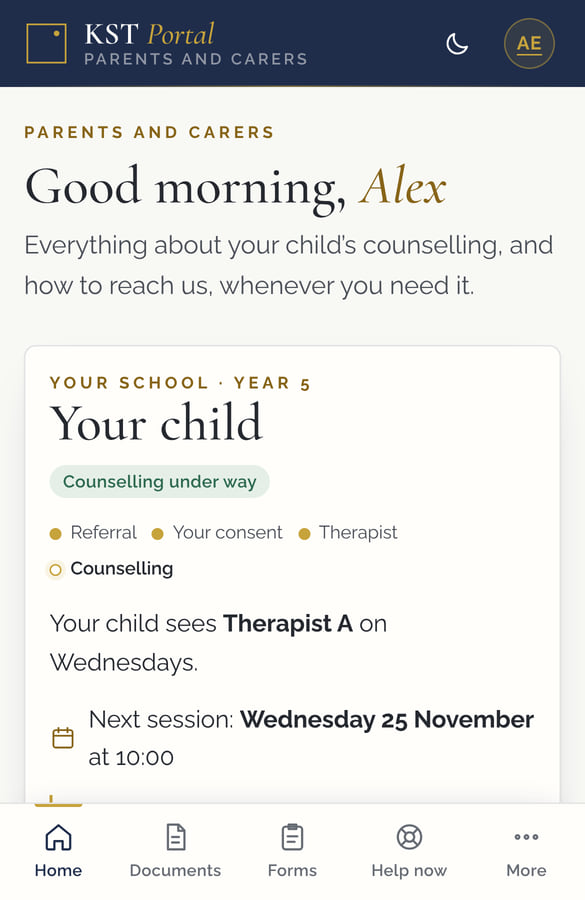
The KST Portal is a private online space with a place for your school and one for each family, and we begin bringing our school partnerships into it from November 2026. Your school’s contact sees what they need to support a pupil, without chasing emails. Parents see their own child’s counselling, and nothing of anyone else’s.

A school contact’s home screen: buttons to refer a pupil or report an absence, counts of pupils in counselling and referrals with KST, a document to read, and this week’s sessions day by day.
A parent’s home screen on a phone: their child’s counselling under way, with the referral, their consent and the therapist done, the day of the week their child is seen, and the next session.
The portal as a school’s contact sees it, and on a phone as a parent sees it. Every record shown is made up.

Your school’s contact

What your school sees

  • Each referral, and where it has got to
  • Who is in counselling, on which days, and whether sessions are attended
  • The lessons pupils miss, across a term or a year
  • An absence, a teacher’s information or a termly update, each sent through a short form
  • Your agreement, our policies, and the information and forms to pass to parents
  • The Parent Book, to search and send to a family

Parents

What parents see

  • Their own child’s counselling: the referral, their consent, the therapist and the next session
  • Updates the therapist chooses to share, and a written follow-up after a parent consultation
  • Documents and forms, and their invoices where they pay
  • A way to message us, or ask for a consultation
  • The numbers to ring if they need help urgently

Confidentiality

What stays private

  • What a child says in sessions stays private, unless a safeguarding concern means it has to be passed on
  • Clinical notes are kept in our clinical records system, never in the portal
  • Anything beyond attendance reaches your school only where a parent has agreed, and we take the young person’s own wishes into account
  • The portal’s emails carry no detail; they say only that something is waiting

Your school’s contact signs in with an emailed code and a second step, a passkey or an authenticator app.

A worry about a child’s safety does not go through the portal. It goes to your school’s DSL, through your school’s own safeguarding procedure. If a child is in immediate danger, call 999.

Safeguarding and governance

The standards beneath every session

KST carries the governance of the work independently of the school, so your team has the assurance without the extra administration.

Safeguarding

Our therapists work within your school’s safeguarding framework. Concerns are reported straight away to your DSL and to KST’s own DSL, Sam McManus, and logged by both. We work in line with Keeping Children Safe in Education 2026 and Working Together to Safeguard Children 2026.

Read our Safeguarding Policy

Vetting

Every therapist holds an enhanced DBS certificate, maintained on the Update Service, and current safeguarding training, and is approved through your school’s own checks before working on site.

Registration and supervision

Every therapist is registered with the BACP, the NCPS or an equivalent professional body, and works under regular clinical supervision with a suitably qualified supervisor.

Insurance

Professional indemnity cover of £5 million and public liability cover of £10 million, held by Kensington Square Therapy with Hiscox.

Records and data

KST is an independent data controller, registered with the Information Commissioner’s Office (ZC022097). Clinical records are encrypted and held by KST, and kept for seven years after therapy ends, or until the young person is 25, whichever is longer.

Read our Privacy Policy

Agreement and notice

Every partnership has a written service agreement. Either side can end it with one full academic term’s notice, which gives every child in ongoing work a planned ending rather than an abrupt one.

In schools now

Where we work

We currently work with Connaught House School, where KST provides counselling under a formal service agreement, and Kensington Prep School, where KST provides the school counsellor and runs 11+ groups.

I would recommend KST without hesitation. In recent years, it has been one of our most impactful pastoral strategies, significantly enhancing the wellbeing of both staff and pupils across the school.

Designated Safeguarding Lead, independent prep school, London

KST has not only provided invaluable therapeutic support for individual pupils, but has also strengthened staff welfare practice across the school, offering colleagues expert guidance, reassurance, and a reflective space to discuss challenges.

Pastoral Lead, London prep school

Questions schools ask

The questions that come up first

We already have a school counsellor. Why would we bring in KST?

Many schools already have some provision, and we are rarely there to replace it. We add capacity when the waiting list outgrows the hours, cover when your counsellor is away, independent supervision for a counsellor you employ, and 11+ groups that run alongside individual work. The aim is to widen what your school can offer without unpicking what already works.

Does it cost the school anything?

That depends on the model. If parents fund sessions, the school carries no cost and no billing. If the school commissions us, it is by the hour or for a half or full day in school. We run both in different schools, and can talk through which suits yours.

How much of our staff’s time will it take?

Very little. We manage clinical records, parental consent and communication with families. Your school’s contact refers through the KST Portal in about a minute, and the school provides a private room; termly reviews keep you informed without adding to the pastoral workload.

Is the KST Portal another system for us to run?

No. The portal is ours to run. We set up your school’s space and invite the parents; your contact signs in with an emailed code and a passkey or an authenticator app. There is nothing to install, we host and look after the portal, and what each person sees follows their role.

How does safeguarding work alongside our own procedures?

Our therapists follow your procedures. Concerns are reported straight away to your DSL and to KST’s DSL, and logged by both. We work in line with Keeping Children Safe in Education 2026 and Working Together to Safeguard Children 2026, and each therapist is approved through your own checks before starting on site.

Who are your therapists?

Experienced therapists with enhanced DBS certificates, current safeguarding training and registration with the BACP, the NCPS or an equivalent body, each working under regular clinical supervision. Our clinical lead, Sam McManus, is a registered member of the BACP and an accredited member of the NCPS, with an MA in Humanistic Counselling Practice and long experience of working in London’s independent schools.

Can we start with something small?

Yes. A single day a week, one 11+ group, or supervision for an existing counsellor are all good places to begin. Beyond a term’s notice, which protects children in ongoing work, there is no minimum commitment and no template you are asked to adopt.

What happens if it is not working, or we need to end it?

Termly reviews mean concerns surface early, while there is still room to adjust. Either side can end the partnership with one full academic term’s notice, so every child in ongoing work has a planned ending rather than an abrupt one.

Begin

If your school is thinking about counselling, we would be glad to talk.

Our clinical lead reads every school enquiry personally, and we aim to reply within one working day. Fees and scope are discussed in the first conversation.